
Guides - 04
Container types and sizes
Most sea freight travels in a handful of standard boxes. Choosing the right one decides how much fits, what it costs and whether special handling is needed.
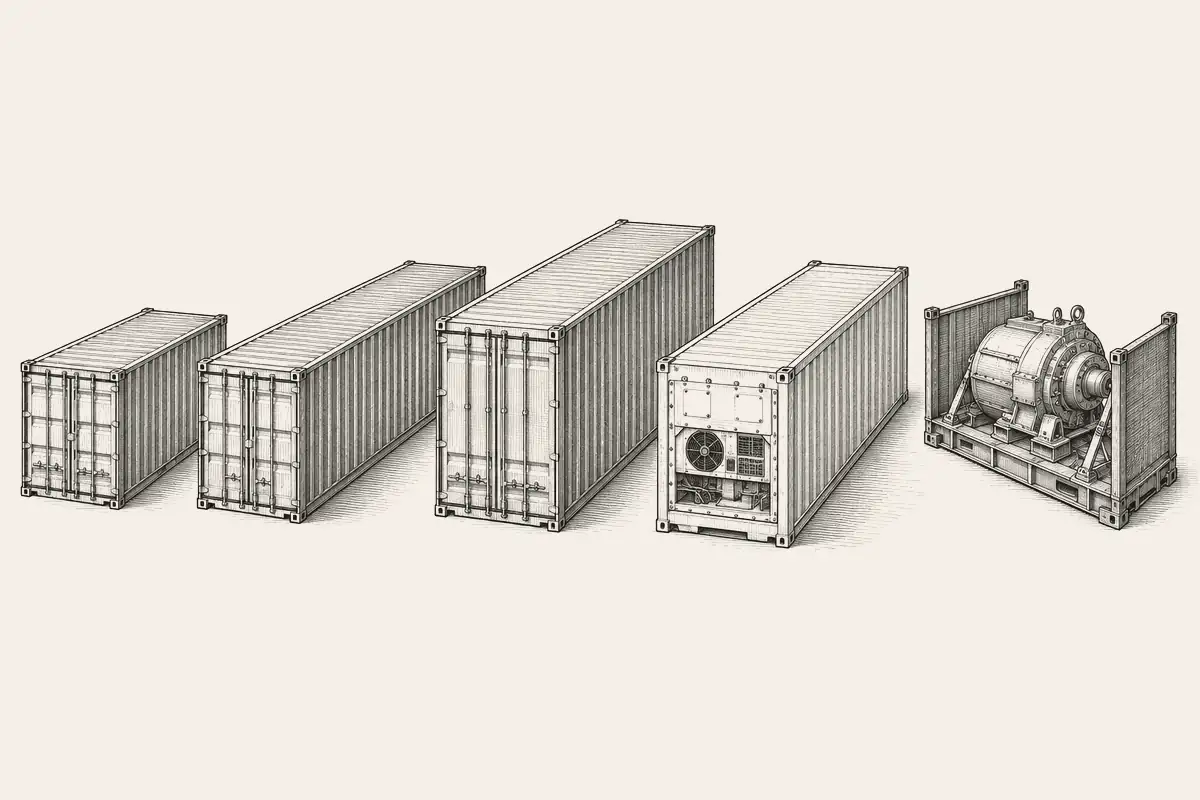
Dry containers
| Type | Internal length x width x height | Volume |
|---|---|---|
| 20ft standard | about 5.90 x 2.35 x 2.39 m | about 33 m3 |
| 40ft standard | about 12.03 x 2.35 x 2.39 m | about 67 m3 |
| 40ft high cube | about 12.03 x 2.35 x 2.69 m | about 76 m3 |
The 20ft box suits heavy, dense cargo, because it reaches its weight limit before it fills. The 40ft and high cube suit lighter, bulkier cargo.
Reefer containers
| Type | Internal length x width x height | Volume |
|---|---|---|
| 20ft reefer | about 5.44 x 2.29 x 2.27 m | about 28 m3 |
| 40ft high cube reefer | about 11.58 x 2.29 x 2.50 m | about 67 m3 |
A reefer has its own refrigeration unit and holds a set temperature. The insulation and machinery take space, so it holds less than a dry box of the same length.
Special equipment
- Open top - a removable roof cover, so tall cargo can be loaded from above by crane.
- Flat rack - a floor with end walls and no sides or roof, for cargo too wide, tall or heavy for a closed box.
- Breakbulk - when even a flat rack will not do, cargo travels loose in the hold or on deck.
Before you book
All sizes here are approximate internal dimensions. Exact figures and the maximum payload vary by carrier and by unit, and road weight limits at either end can be lower than the container's own limit. We confirm the figures for your booking.
Not sure which box you need? Our freight calculators give the volume of your cargo in cubic metres.
Services that use this
- Full container load (FCL)A container for your cargo alone.
- Less than container load (LCL)Space in a shared container.
- Temperature-controlled cargoReefer containers and cool-chain air freight.
- Project and out-of-gauge cargoHeavy, long, wide or tall cargo.
Send us the details.
Tell us the cargo, the route and the dates. We will reply by email with what we can arrange.